

Michael Baggott was, without a doubt, one of the most genuine and knowledgeable voices in the British antiques world. From saving up school dinner money as a child to becoming the Head of Silver at one of the most prestigious auction houses on the planet, his journey is nothing short of extraordinary. Well, it’s fair to say that his story is the kind that reminds you — passion really does open doors. This article dives deep into the life, career, achievements, and lasting legacy of Michael Baggott, celebrating the man who made antique silver feel exciting, accessible, and absolutely fascinating to millions of viewers across the United Kingdom.
Who Was Michael Baggott? An Introduction to a True Antiques Legend
Born on 18 April 1973 in Birmingham, England, Michael Baggott grew up in circumstances that were, by his own admission, quite humble. His father was a wholesale market trader and a boxer — a background that gave Michael a grounded, unpretentious outlook on life that never left him. He was raised on what he described as one of the roughest council estates in Birmingham, yet it was precisely this upbringing that shaped his fierce work ethic and his sharp eye for value — both in objects and in people.
What made Michael so endearing wasn’t just his expertise. It was the fact that he wore his heart on his sleeve. He was the kind of bloke who’d sit in a dusty saleroom and absolutely light up when he spotted something rare in a cardboard box. That genuine enthusiasm was magnetic, and it’s a big reason why audiences trusted him completely.
He passed away on 27 January 2025, following a stroke in October 2024 and a subsequent heart attack at Good Hope Hospital in Birmingham. He was just 51 years old. His death left a significant void in the British antiques community, with tributes pouring in from colleagues, fans, and fellow experts across the country.
Michael Baggott’s Early Life and the Spark That Started It All
Every great expert has an origin story, and Michael Baggott’s is particularly charming. As a schoolboy, he became captivated by antiques — not through a wealthy family collection or a grand country estate, but through sheer curiosity and determination. He saved up £22 in school dinner money — yes, you read that right — and used it to purchase his very first antique: a Chester silver Vesta case. That single purchase changed the entire direction of his life.
From that moment on, Michael was hooked. He sat the 11-plus exam and attended a grammar school, which he later credited with transforming his life’s path. He was passionate about the idea that education could lift anyone, regardless of background, and he spoke about this publicly and with great conviction. After grammar school, he went on to study Fine Arts Valuation at the University of Southampton — a degree that gave him the academic framework to match his natural talent.
Key highlights of his early journey include:
- Growing up on a council estate in Birmingham, which instilled resilience and a no-nonsense attitude
- Saving school dinner money to buy his first antique at age 13 — a Chester silver Vesta case for £22
- Passing the 11-plus and attending grammar school, which he viewed as a life-changing opportunity
- Studying Fine Arts Valuation at the University of Southampton
- Beginning his auction house career at Christie’s during his university years
It’s the kind of backstory that makes you sit up and take notice. This wasn’t a man who was handed opportunity — he chased it with both hands.
A Career Built on Expertise: From Christie’s to Sotheby’s
After completing his degree, Michael Baggott wasted no time in throwing himself into the world of high-end auction houses. He joined Christie’s during his university years, cutting his teeth in one of the most competitive and intellectually demanding environments in the global art and antiques market.
He then moved to Sotheby’s, where he eventually became the Head of Silver at Sotheby’s Billingshurst — a prestigious role that placed him at the very top of the antique silver trade in the United Kingdom. For four years, he ran the silver department with authority and precision, building relationships with collectors, dealers, and institutions across the world.
His specialisations were highly specific and deeply researched:
- Early English silver spoons — a niche area requiring exceptional knowledge of period craftsmanship
- Smallwork — intricate, detailed silver objects that demanded a trained eye
- Boxes and vinaigrettes — decorative and functional pieces from various historical periods
- Continental silver — European pieces that required knowledge of foreign hallmarking systems
After his time at Sotheby’s, Michael transitioned into life as a freelance consultant and private dealer — a move that gave him the freedom to work on his own terms while continuing to contribute to the antiques world in meaningful ways. He provided private valuations, advised collectors, and helped authenticate rare pieces for institutions and individuals alike.
Rising to Fame: Michael Baggott on BBC’s Flog It!
If there’s one thing that truly brought Michael Baggott into the living rooms of millions, it was his work on the BBC’s beloved daytime programme, Flog It!. Hosted by the affable Paul Martin, the show ran for a remarkable 17 years and more than 1,000 episodes from 2002, inviting members of the public to bring their treasured possessions to be valued and potentially sold at auction.
Michael joined the Flog It! team in 2004, and he quickly became one of its most recognisable and respected faces. Unlike some television experts who can come across as stiff or patronising, Michael had a warmth and a dry wit that made him instantly likeable. He could explain a complex piece of hallmarking history in a way that felt natural and conversational — never dumbed down, but always accessible.
His most memorable moment on the show He recalled it as handling a silver trophy made by Fabergé as an award for the best car of 1924 — a once-in-a-career encounter that left even an expert like him absolutely gobsmacked.
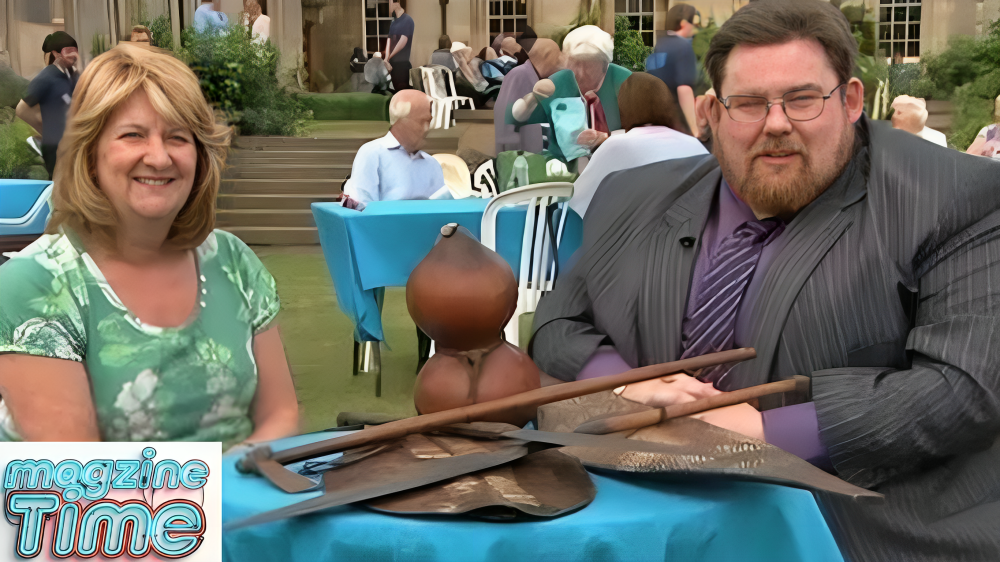
There was also the famous moment in 2012 when Flog It! visited Normanby Hall in Lincolnshire. Michael was asked to examine a collection that the owner believed was African tribal art, which he valued at £200–£400. When it went to auction, the collection turned out to be Aboriginal art, containing a rare broad shield — and it sold for an astonishing £30,000 to the Sydney Museum of Primitive Art. Rather than hiding from this error, Michael addressed it with admirable honesty: “This is what antiques are all about — you can’t be an expert on everything, and you never stop learning.”
Michael Baggott on Antiques Roadshow and Going for a Song
Michael Baggott’s television career was not limited to Flog It!. He was also a familiar face on two other iconic BBC programmes: Antiques Roadshow and Going for a Song. Together, these appearances cemented his status as one of the most trusted antiques authorities on British television over a period of more than 20 years.
On Antiques Roadshow, Michael brought the same calm authority and meticulous attention to detail that made him so effective on Flog It!. The show’s format — meeting members of the public at historic venues and evaluating their cherished objects — allowed him to shine. His comments on silver pieces were always precise, historically rich, and genuinely illuminating for viewers at home.
Going for a Song, one of the BBC’s oldest antiques programmes, provided yet another platform for Michael to share his expertise with a wide audience. His cumulative television work helped introduce the intricacies of antique silver — hallmarks, assay offices, maker’s marks, dating — to audiences who might never have otherwise engaged with the subject.
The breadth of his television work tells you everything you need to know about how highly regarded he was by the BBC.
Published Author and Researcher: Michael Baggott’s Literary Contributions
Beyond the television cameras, Michael Baggott was a serious scholar of antique silver.
| Publication | Description |
| An Illustrated Guide to York Hallmarks 1776–1858 | A detailed academic reference on regional silver assay marks from York |
| As Found: A Lifetime in Antiques | A self-published memoir recounting his journey in the antiques trade |
| Articles in The Finial | Multiple contributions to the journal of the Silver Spoon Club of Great Britain |
Michael’s research gave collectors a comprehensive tool for dating and authenticating York silver pieces — a resource that was previously lacking and that the collecting community genuinely needed.
The York Silver Collection: A Lifetime’s Work
One of the most remarkable aspects of Michael Baggott’s legacy is the extraordinary private silver collection he spent his lifetime assembling. His York silver collection alone comprised more than 550 pieces, spanning from the late 17th century all the way to 1858 — the year York’s assay office closed its doors for the last time.
After his passing in January 2025, his collection was sold in a series of auction sales at Woolley and Wallis. The results were remarkable:
- The first two auction sales exceeded £200,000 in combined sales
- The final instalment of the collection, held in early 2026, sold for £112,891 — above its estimated value of £71,100–£97,700
- A Charles II provincial two-handled porringer by silversmith Thomas Mangy, York 1672, sold for £3,810
These figures confirm what those in the trade had always known: Michael Baggott’s eye for quality was second to none. He didn’t just talk about antique silver — he lived it, breathed it, and built one of the most significant collections of provincial English silver in private hands.
Michael Baggott’s Personality, Social Media, and Public Voice
He maintained an active presence on social media — particularly on X (formerly Twitter), where he had over 9,000 followers — and he used these platforms to share his professional insights, his personal opinions, and his very human struggles.
He was open about his health challenges, including his weight and his stroke in late 2024. His willingness to speak out publicly about his treatment showed a man who was unafraid to use his platform for something beyond antiques.
The Legacy of Michael Baggott: A Giant of the Antiques Industry
When Michael Baggott passed away on 27 January 2025, the tributes came flooding in from every corner of the British antiques world — and the warmth of those messages said everything about the kind of man he was.
His legacy rests on several pillars:
- Television education — Over 20 years on BBC television, he introduced millions of viewers to the world of antique silver and collectibles
- Academic contribution — His published research, particularly on York hallmarks, remains a key reference for collectors and dealers
- Authentic passion — He demonstrated that genuine enthusiasm, not just professional credentials, is what truly connects an expert with their audience
- Community building — Through social media and his Substack newsletter, he built a loyal, engaged community of antiques enthusiasts
The antiques world is quieter without him — but the mark he left on it is permanent.
What Michael Baggott Taught Us About the Value of Passion
Looking back at the life of Michael Baggott, there’s a lesson here that goes well beyond hallmarks and auction paddles. His journey — from a council estate in Birmingham to the corridors of Christie’s and Sotheby’s, from Flog It!
He didn’t come from privilege. He didn’t have connections. What he had was a £22 Chester silver Vesta case and an unquenchable curiosity about the objects that carry history within them. And from that small beginning, he built something remarkable.
He also showed that expertise, real expertise, is not about being the loudest voice in the room. It’s about being the most honest one. When he got something wrong on Flog It! — like that Aboriginal shield — he didn’t make excuses. He said, plainly and without embarrassment: “You never stop learning.” That’s the mark of a great teacher, and a great human being.
For anyone who loves antiques, who watches Flog It! reruns, or who has ever wandered into a charity shop hoping to find something wonderful, Michael Baggott is a reminder that this world has room for passionate, knowledgeable, genuine people — and that the joy really is in the discovery.
Conclusion
Michael Baggott was far more than a television personality or a silver dealer. He was an educator, a scholar, a collector, a writer, and — above all — a man who genuinely loved what he did. From his early days saving school dinner money to buy his first antique, to the remarkable legacy of his 550-piece York silver collection, his life told the story of what happens when passion meets hard work and intellectual rigour.
He spent over two decades on BBC television, sharing his extraordinary knowledge with millions of viewers and making antique silver feel alive, relevant, and endlessly fascinating. His published works continue to inform collectors and dealers. His social media presence helped build a vibrant community of antiques enthusiasts. And his auction results — achieved posthumously — confirmed what the trade had always known: Michael Baggott had one of the finest eyes in the business.
FAQs
Who was Michael Baggott?
Michael Baggott was a British antiques expert, dealer, and television personality best known for his appearances on BBC programmes including Flog It!, Antiques Roadshow, and Going for a Song. He was a specialist in antique silver, particularly early spoons, smallwork, and provincial British and continental silver.
What was Michael Baggott best known for?
Michael Baggott was best known for his long-running role as an expert on the BBC daytime programme Flog It!, which he joined in 2004.
When did Michael Baggott die?
Michael Baggott passed away on 27 January 2025, following a stroke in October 2024 and a subsequent heart attack at Good Hope Hospital in Birmingham. He was 51 years old.
What books did Michael Baggott write?
Michael Baggott authored An Illustrated Guide to York Hallmarks 1776–1858, a detailed academic reference work, and As Found: A Lifetime in Antiques, a personal memoir about his life in the antiques trade. He also contributed numerous articles to The Finial, the journal of the Silver Spoon Club of Great Britain.
What happened to Michael Baggott’s silver collection after his death?
Following Michael Baggott’s death in January 2025, his private silver collection was sold in a series of auction sales at Woolley and Wallis.



